KNOWLEDGE PORTAL
Summary
In this article:
- Why enterprises are asking this question now
- What Palantir AIP and Foundry actually are
- The three things that actually determine the right fit
- Side-by-side comparison
- Be honest: which platform is actually right for you?
- Why Cyberhill can speak to both sides
- Frequently asked questions
Palantir’s commercial momentum is real. AIP and Foundry are genuinely powerful platforms, and for certain organizations, they’re the right call. But “powerful” and “right for your enterprise” are not the same thing.
This piece is for decision-makers evaluating Palantir AIP and want a straight answer — not a hit piece, not a marketing brochure dressed up as analysis. We’ll cover the architecture, the cost structure, what you actually own when the engagement ends, and the specific organizational profiles where each platform makes sense.
Disclosure
Cyberhill’s founders spent 7+ years deploying operational AI inside the U.S. Department of Defense and Intelligence Community — the same environment where Palantir made its name. We know what this comparison looks like from the inside. We also make Cerebro, which is one of the alternatives discussed here. We’ve tried to be fair; you should weigh that context accordingly.
Palantir AIP vs. Cerebro: Side-by-Side Comparison
| Dimension | Palantir AIP / Foundry | Cerebro by Cyberhill |
| Architecture | Proprietary platform with open APIs at select tiers | Open standards throughout — RDF, OWL, PROV-O, OpenAPI |
| Data Migration | Data ingestion into Foundry required for full functionality | None — deploys on your existing infrastructure, data stays at rest |
| IP Ownership | You license the platform; Palantir owns the software | Client owns all models, ontology, code, and IP — capitalizable under GAAP |
| Explainability | Governance and auditability within the platform | Ontology-driven, fully traceable and auditable by design |
| Deployment Timeline | Months depending on data complexity | Days — 80% pre-built, 20% customized to your environment |
| Certifications Required | Extensive — Foundry Aware, AIP Builder, Data Engineer tracks | None — Cyberhill’s team handles engineering |
| Cost Structure | Custom enterprise pricing; usage-based compute, storage, and ontology | Fixed engagement model; fraction of platform program cost |
| Vendor Dependency | Platform updates required; ongoing licensing | None — you own and sustain everything. Cyberhill is there when needed. |
| Model Agnosticism | LLM integration within AIP framework | Fully model-agnostic — ChatGPT, Gemini, Llama, or custom |
Why Enterprises Are Asking This Question Now
Palantir’s AIP platform launched commercially in 2023 and has grown fast. The “AIP Bootcamp” model (intensive, hands-on, rapid deployment) has given the company a compelling answer to the “how long does this take” question that plagued earlier Foundry implementations.
But growth has surfaced friction. Across enterprise AI evaluations in 2025 and 2026, three concerns consistently come up.
1. The Certification Barrier
Getting a team production-ready on Palantir AIP means working through multiple certification tracks. Foundry Aware, Application Developer, Data Engineer, AIP Builder; each requires dedicated staff time and platform access, often months of ramp-up before a single business outcome is delivered. For lean technical teams or compressed timelines, this cost rarely appears in initial pricing conversations.
The IP question
Your data can be exported from Foundry. That part is true and documented. But the ontology, workflows, object types, and operational logic you build inside the platform are constructed using Palantir’s proprietary architecture. That layer doesn’t travel when you do. And IP built on top of a licensed platform is, by definition, licensed IP: you access it, you don’t own it the way you’d own code built on open infrastructure.
2. The IP Question
Your data can be exported from Foundry. That part is true and documented. But the ontology, workflows, object types, and operational logic you build inside the platform are constructed using Palantir’s proprietary architecture. That layer doesn’t travel when you do. And IP built on top of a licensed platform is, by definition, licensed IP: you access it, you don’t own it the way you’d own code built on open infrastructure.
3. The Cost Structure
Palantir’s enterprise pricing is custom, usage-based, and negotiated individually. Compute, storage, and ontology volume are priced separately. For large-scale deployments, costs compound in ways that are genuinely difficult to model upfront. User reviews and industry reporting flag cost unpredictability consistently as a top concern.
Worth noting
None of these concerns makes Palantir a bad choice. They make it a specific choice, one that requires a specific kind of organization to get full value from it. More on that below.
What Palantir AIP and Foundry Actually Are
A common source of confusion in these evaluations: Palantir has multiple products with overlapping scope, and buyers sometimes conflate them.
Palantir Foundry
Foundry is the data integration and ontology platform. It’s the backbone that ingests, structures, and connects enterprise data. It’s also where your data engineers and analysts spend most of their time, building pipelines, defining object types, and creating the semantic layer that everything else depends on.
Palantir AIP
AIP (Artificial Intelligence Platform) sits on top of Foundry and adds the LLM and AI orchestration layer. It’s what allows teams to build AI-powered applications, automate workflows, and interact with their data using natural language. AIP requires Foundry. You can’t run AIP without the Foundry data layer underneath it.
Palantir Apollo
Apollo is the continuous deployment system that manages Palantir software across cloud, on-premises, and classified environments. It’s what allows Palantir to operate in air-gapped government settings. Most commercial buyers won’t interact with Apollo directly, but it’s part of the infrastructure picture.
Understanding this architecture matters for the comparison that follows, because much of what makes Palantir powerful is also what creates the dependencies enterprises need to plan around.
The Three Things That Determine the Right Fit
1. Who Owns the Intelligence You Build?
This is the most important question in any enterprise AI evaluation, and the one most platform vendors are least eager to answer directly.
Palantir’s documentation states clearly that data can be exported from Foundry in non-proprietary formats. That’s accurate. But enterprise AI isn’t just data. The value is in the structured intelligence layer built on top of that data: the ontology, the object types, the action frameworks, the pipelines. That layer is built using Palantir’s proprietary architecture. When you leave, it stays.
More fundamentally: IP built on top of a licensed platform is licensed IP. You pay to access it. You don’t own it in the same way you own code you write on open infrastructure.
Cerebro is built end-to-end on open standards: RDF, OWL, PROV-O, and OpenAPI. The ontology Cyberhill engineers for your environment is your IP. It’s a capitalizable asset on your balance sheet under GAAP. When the engagement ends, everything stays with you. No re-licensing. No dependency on Cyberhill to keep it running.
2. What Does It Cost, Including Everything?
Palantir’s pricing is custom and usage-based. Compute, storage, and ontology volume priced separately. Enterprise contracts are negotiated individually. This makes true cost comparison difficult, but consistently surfaced concerns include:
- Internal staff time required for certification and ongoing platform expertise
- Multiple platform instances required for hands-on training
- The gap between contract signing and the first measurable business outcome
- Ongoing licensing that doesn’t decrease as your AI matures
Cerebro runs on a fixed engagement model. You know the cost before you start. Deployment happens in days, which means you’re measuring business outcomes almost immediately, not funding months of setup before value appears.
3. How Long Until You’re In production?
Palantir’s AIP Bootcamp model has genuinely compressed timelines. “Rapid” in Palantir terms typically still means weeks to months, and it requires your team to be trained and certified to operate the platform. The bootcamp gets you started; sustaining production requires ongoing internal expertise.
Cerebro deploys in days. Not because it’s simpler, but because it’s 80% pre-built and deployed by Cyberhill’s AI engineering team. You don’t need certified staff, Palantir-credentialed engineers, or multiple platform instances to get started. The dedicated Cerebro AI team includes PhD Data Scientists, Ontology & Knowledge Graph Engineers, AI Solution Architects, Enterprise Data Engineers, AI Security & Governance Specialists, MLOps Engineers, Full-Stack / AI Application Engineers, Cleared Personnel (TS/SCI), AI Engagement Leads, LLM / Prompt Engineers, and Domain Solutions Leads
Which Is the Right Fit For Your Business?
The right platform depends on your organization’s technical capacity, timeline, budget, and tolerance for vendor dependency. Here’s where each one genuinely fits.
Palantir AIP/Foundry is likely the right choice if:
- You have a large, dedicated data engineering team prepared to invest in certification and platform expertise
- You want a fully managed, end-to-end platform where Palantir handles underlying infrastructure complexity
- You’re already operating within a Palantir environment, and the switching cost outweighs the benefits of change
- You have a multi-year AI transformation budget and want a single platform vendor managing the full relationship
- You operate in defense or government and want the deepest possible integration with existing Gotham or Apollo deployments
- You have the internal capacity to build and sustain a Palantir-certified engineering team over time
Cerebro is likely the right choice if:
- You need production AI in days, not months — on your existing data and infrastructure
- Your team can’t absorb a months-long certification program before seeing results
- You want to own the IP you build — as a capitalizable asset, not a licensed dependency
- Your data needs to stay where it is — no migration, no leaving your perimeter
- You want model agnosticism — the freedom to use ChatGPT, Gemini, Llama, or your own models without platform constraints
- You’re a mid-market enterprise where a $5–20M annual platform spend doesn’t fit the business model
- You want to prove value on one high-impact use case before committing to a full platform program
The Exit Test
Before signing any enterprise AI contract, ask one question: “What happens in Year 3 if we want to switch?” With Palantir, your data exports, but the ontology, workflows, and operational logic stay in the platform. Rebuilding that intelligence layer on a new system is a multi-month, multi-million-dollar project. With Cerebro, everything is yours. Open standards. Portable ontology. No re-licensing.
Why Cyberhill Can Speak to Both Sides
Cyberhill’s founding team has spent 7+ years building and deploying operational AI inside the U.S. Department of Defense and Intelligence Community. This is the same environment where Palantir built its government reputation. We’ve seen what it costs to sustain a platform program at scale and what breaks when the environment changes faster than the platform can adapt.
That experience led us to build a different path. Not a platform that wraps your data in proprietary architecture, but a bespoke, open-standards AI solution that deploys on your existing infrastructure, produces IP you own, and delivers results on a timeline that matches your business — not a vendor’s implementation roadmap.
- 4x improvement in AI accuracy using ontology-driven validation vs. standard approaches. In Cyberhill’s internal testing across 43 enterprise-grade queries on complex data schemas, ontology-based query validation improved AI accuracy by more than 4x compared to standard approaches.
- 20% faster deployment and 50% reduction in course duplication — U.S. Air Force curriculum management
- Selected from 78 companies to build AI at national scale for the Department of Defense
- $11M in strategic investment from Baleon Capital, validating enterprise demand for a faster, lower-risk path to production AI
Cerebro is not for every enterprise. But for the organizations that want to own their AI, keep their data where it is, and build capitalizable IP on a timeline that matches their business, there isn’t a faster or lower-risk path to production.
See How Cerebro Compares for Your Specific Environment
Every enterprise is different. The right platform depends on your data environment, your team’s capacity, your timeline, and your budget. If you’re evaluating enterprise AI options and want a straight answer on whether you’re on the right path, bring us your use case, and we’ll workshop it together.
Cyberhill’s AI team will review your environment, discuss your requirements, and give you an honest assessment. No sales pitch. Just an honest conversation about where Cerebro fits and where it doesn’t.
Book Your 30-Minute AI Strategy Session
Or call us directly: 737-301-5856
Frequently Asked Questions
What’s the difference between Palantir Foundry and Palantir AIP?
Foundry is Palantir’s core data integration and ontology platform. It’s where data is ingested, structured, and connected into a semantic layer. AIP (Artificial Intelligence Platform) layers on top of Foundry to add LLM orchestration, natural language interaction, and AI application development. AIP cannot run without Foundry underneath it. Most commercial enterprise buyers are purchasing both, which is worth clarifying during initial pricing conversations.
Can I export my data and IP if I leave Palantir?
Your underlying data can be exported from Foundry in non-proprietary formats; Palantir’s documentation is clear on this. What doesn’t export cleanly is the intelligence layer built on top of that data: the ontology, object types, pipelines, and action frameworks you’ve constructed inside the platform. Those are built using Palantir’s proprietary architecture, and rebuilding them outside the platform requires significant time and investment. It’s the difference between owning your data and owning your AI.
How does Palantir AIP pricing work?
Palantir’s enterprise pricing is custom and negotiated individually. Compute, storage, and ontology volume are typically priced separately, and costs scale with usage. This means the full cost of a large-scale deployment is genuinely difficult to model upfront, which is why user reviews and industry reports consistently flag cost unpredictability as a concern. When evaluating Palantir, ask specifically about what’s included in the base contract vs. what triggers additional charges as your use cases expand.
How long does it take to get to production with Palantir vs. an alternative like Cerebro?
Palantir’s AIP Bootcamp model has compressed timelines significantly, but “rapid” in Palantir terms typically means months, depending on data complexity and team readiness. Your team also needs to be trained and certified to operate the platform before you’re in true production. Cerebro deploys in days because it’s 80% pre-built and deployed by Cyberhill’s engineering team directly. You don’t need to certify internal staff or run parallel platform instances to get started.
Do I need to hire or certify staff internally to operate Palantir AIP?
Yes, in most implementations. Getting a team production-ready on Palantir requires working through certification tracks, including Foundry Aware, Application Developer, Data Engineer, and AIP Builder. Each requires dedicated time, platform access, and typically months of ramp-up. This is a real cost that often doesn’t appear in initial pricing conversations. Organizations with lean technical teams or aggressive timelines should factor this into their evaluation.
Does Cerebro work with my existing data infrastructure, or do I have to migrate?
No migration required. Cerebro deploys on your existing infrastructure and connects to your data where it already lives. It doesn’t require ingestion into a new platform environment. Your data stays at rest, in your perimeter, under your control. This is one of the more meaningful architectural differences between Cerebro and Palantir Foundry, which does require data to be ingested into the Foundry environment for full functionality.
Is Cerebro model-agnostic? Can I use it with ChatGPT, Gemini, or my own models?
Yes. Cerebro is fully model-agnostic. It can work with ChatGPT, Gemini, Llama, or custom models you’ve built internally. The ontology layer is what provides structure, governance, and explainability — not a dependency on any specific LLM. This gives enterprises the flexibility to swap models as the landscape evolves without rebuilding their AI infrastructure.
What does Cerebro IP ownership mean? Is it capitalizable under GAAP?
When Cyberhill builds an ontology and AI solution for your organization, everything produced (the ontology, models, code, and IP) is yours. Built on open standards (RDF, OWL, PROV-O, OpenAPI), it’s portable, auditable, and not dependent on any Cyberhill license to keep running after the engagement ends.
From a GAAP standpoint, internally developed software and AI assets built on open infrastructure can qualify as capitalizable intangible assets under ASC 350-40. Your accounting team should confirm applicability for your specific situation, but the structural condition is met in a way it isn’t when the IP lives inside a licensed platform.
Can Cyberhill help us migrate off Palantir?
Yes. Our team has operated inside the same environments where Palantir is deployed, we know exactly what’s exportable, what needs to be rebuilt, and where your IP actually lives inside Foundry. We’ll assess your current environment, reconstruct your intelligence layer on open-standards architecture, and make sure everything you’ve built comes with you. Owned by you and not licensed by anyone. To get a read on scope and timeline, book a call with our team.
You might also be interested in
18 May, 2026

Cyberhill Develops AI-Enabled Biosurveillance Mission Applications for the Department of War on the ServiceNow AI Platform
Cyberhill is developing BIP, an AI-enabled biosurveillance capability on the ServiceNow AI Platform, giving the Department of War a single environment to detect and respond to biological threats.
LEARN MORE
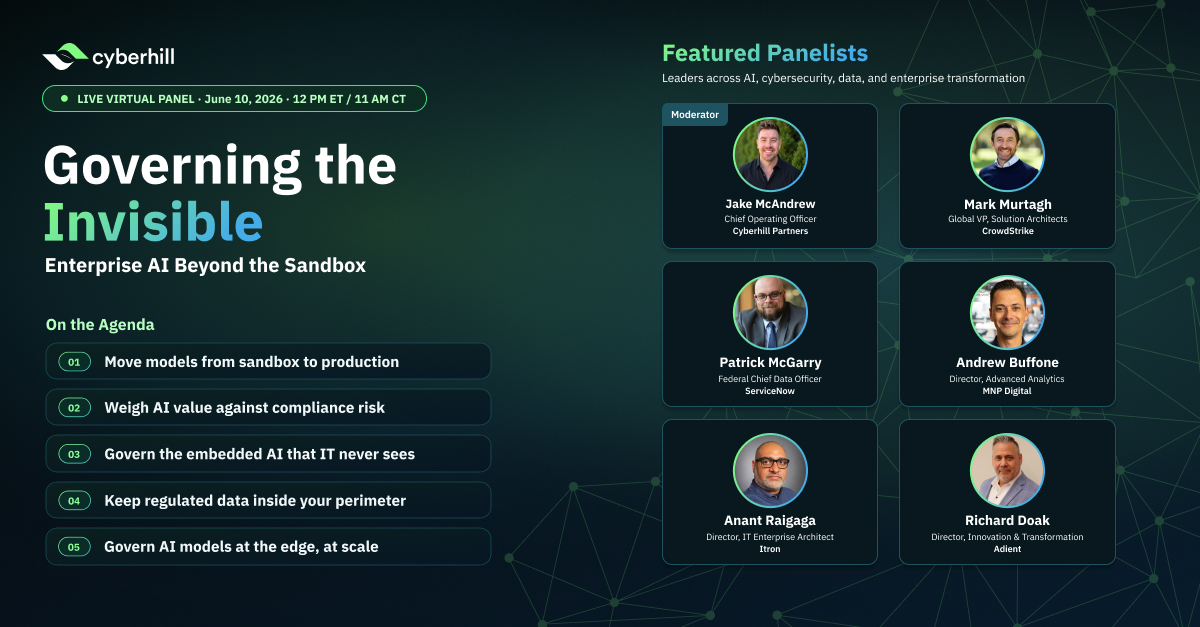
Governing the Invisible: Enterprise AI Beyond the Sandbox
Learn from leaders in the AI Governance space about moving models into production, governing embedded AI, and keeping regulated data inside your perimeter.
LEARN MORE

The Hidden Cost of Enterprise AI Platforms: Why the Biggest Risk Isn’t the Technology
Only 6% of enterprises could walk away from their AI vendor without disruption. The real cost of enterprise AI isn't the license — it's what you give up.
LEARN MORE