KNOWLEDGE PORTAL
Summary

Only 6% of enterprises could walk away from their AI vendor without disruption. The rest are locked in — and paying for it in ways that never appear on the invoice.
The real cost of enterprise AI isn’t the license. It’s the intelligence you can’t take with you, the total cost you can’t predict, and the certification tax that delays ROI by months. Here’s how to spot the difference between buying a tool and entering a dependency — before you sign.
The Hidden Cost of Enterprise AI Platforms: Why the Biggest Risk Isn’t the Technology
Enterprise AI spending is accelerating. Gartner projects worldwide AI software revenue will surpass $250 billion by 2027. Every major consultancy has an AI practice. Every enterprise software vendor has bolted “AI-powered” onto their product page. The technology works. That part is settled.
What isn’t settled is who benefits when it does.
A recent survey of 542 U.S. enterprise executives found that 74% would experience day-to-day operational disruption — or worse — if their primary AI vendor’s services ended tomorrow. Only 6% said they could walk away without interruption. That’s not adoption. That’s dependency. And dependency has a cost that never appears on the invoice.
This post isn’t about any one vendor. It’s about a structural problem in how enterprise AI is sold, bought, and sustained — and why the organizations getting the most value from AI are the ones who refused to accept the default terms.
The Three Costs Nobody Quotes
1. The Intelligence You Build Isn’t Yours
When an enterprise deploys an AI platform, the work doesn’t stop at installation. Teams spend months — sometimes years — building ontologies, training models, configuring workflows, and encoding institutional knowledge into the system. That intelligence layer is where the real value lives. It’s what turns raw data into decisions.
On most platforms, that layer is inseparable from the vendor’s proprietary architecture. Your data can be exported. The intelligence you built on top of it largely cannot. The ontology, the object types, the action frameworks, the pipeline logic — all of it is constructed using the vendor’s proprietary tooling. It lives inside their system. When the contract ends, the data travels. The intelligence stays.
This isn’t a hypothetical. Among enterprises that have attempted to migrate between AI platforms, 58% report the process either failed outright or required significantly more effort than expected. The reason isn’t technical complexity alone — it’s that the most valuable work product is architecturally bound to the platform it was built on.
The accounting implications are equally significant. IP built on open standards — using frameworks like RDF, OWL, or OpenAPI — can be capitalized as an asset on the balance sheet under GAAP. IP built inside a licensed platform is licensed IP. You pay to access it. You don’t own it the way you own code written on your own infrastructure.
For enterprises spending millions on AI, the question isn’t “does it work?” It’s “who owns what we built when we’re done?”
2. The Total Cost Is Unknowable Until You’re Already In
Enterprise AI platforms typically price on a combination of compute, storage, data volume, and seat licenses — each negotiated individually, each scaling independently. This makes true cost modeling before deployment functionally impossible.
The visible costs are the license, the implementation partner, and the cloud infrastructure. The invisible costs are what compound:
The Pendo 2024 benchmark report found that average enterprise feature adoption for digital products is just 6%. The Zylo 2023 SaaS Management Index found that the average organization wastes $17 million annually on unused software licenses. These aren’t AI-specific numbers, but they describe the same dynamic: enterprises buy platforms designed to solve many problems, then use a fraction of what they’re paying for.
In AI specifically, the hidden costs are more acute. A 2026 Zapier survey found that 46% of enterprise leaders cite data migration challenges as a primary vendor lock-in risk, and 41% cite sudden price increases. When your AI vendor controls the infrastructure, the pricing, and the architecture your intelligence layer depends on, every renewal is a negotiation where one side holds all the leverage.
The alternative isn’t “no AI.” It’s AI structured so that cost is knowable before you start, and the value you build doesn’t depreciate the moment you stop paying.
3. The Certification Tax
This is the cost that almost never appears in vendor comparisons, and it may be the most consequential.
Most enterprise AI platforms require internal teams to complete extensive certification programs before they can operate the system in production. These aren’t optional tutorials — they’re prerequisites. Foundry Aware, Application Developer, Data Engineer, AIP Builder — each track requires dedicated staff time, platform access, and months of ramp-up.
For organizations with large, well-funded data engineering teams, this is manageable. For everyone else — mid-market enterprises, organizations with lean technical teams, companies that need results on a business timeline rather than a training timeline — the certification requirement creates a months-long gap between signing the contract and delivering the first business outcome.
During that gap, the enterprise is paying for a platform it can’t yet use at full capacity, training staff on proprietary tooling that has no value outside the vendor’s ecosystem, and deferring the ROI that justified the purchase in the first place.
The certification tax isn’t just time and money. It’s organizational lock-in. Once your team is certified on a proprietary platform, switching means retraining — which means the switching cost isn’t just technical. It’s human capital.
Why 70–90% of Enterprise AI Projects Fail — and It’s Not the AI
The failure rate of enterprise AI projects has been remarkably consistent across multiple research sources: RAND Corporation estimates over 80% fail, at twice the rate of non-AI technology projects. McKinsey, Gartner, and others have reported similar ranges, typically between 70% and 90%.
The instinct is to blame the technology. But the research consistently points elsewhere. A 2025 analysis found that 85% of AI failures are strategic, not technical — driven by bad data, misaligned objectives, and organizational resistance rather than algorithmic shortcomings.
The platform model contributes to this dynamic in a specific way: it front-loads complexity. Before an enterprise can test whether AI solves a specific business problem, it must first adopt an entire platform, migrate or integrate data, train staff, and build within a proprietary architecture. By the time the first use case reaches production, the organization has already committed millions of dollars and months of effort — with no guarantee the approach fits the problem.
The organizations that consistently succeed with enterprise AI tend to share a common trait: they start with a specific problem, prove value quickly, and scale from there. They don’t adopt a platform and then go looking for use cases to justify it.
The Exit Test
Before signing any enterprise AI contract, there is one question that reveals more about the vendor relationship than any demo, POC, or reference call:
“What happens in Year 3 if we want to switch?”
If the answer involves rebuilding your ontology, retraining your models, re-engineering your workflows, and re-certifying your team on a new platform — you’re not buying a tool. You’re entering a dependency.
If the answer is “everything you built is yours, on open standards, and it runs on your infrastructure” — you’re buying an asset.
The difference between those two answers is the difference between renting intelligence and owning it.
A Different Architecture Exists
The platform model isn’t the only way to deploy enterprise AI. It’s the most marketed way. It’s the way with the largest sales teams and the most analyst coverage. But it’s not the only architecture that works.
There is a growing category of enterprise AI that operates on a fundamentally different premise: deploy on the customer’s existing infrastructure, build on open standards, deliver IP the customer owns, and get to production in days rather than months.
Cyberhill Partners built its AI practice inside this model. Our founding team spent 7+ years deploying operational AI inside the U.S. Department of Defense and Intelligence Community — environments where vendor lock-in isn’t just expensive, it’s a national security risk. That experience shaped an architecture designed around a simple principle: the enterprise should own everything the AI produces.
Cerebro, Cyberhill’s semantic intelligence engine, is built entirely on open standards — RDF, OWL, PROV-O, OpenAPI. It deploys on existing infrastructure without data migration. The ontology, the models, and the code are the client’s IP — capitalizable under GAAP. Deployment happens in days because the architecture is 80% pre-built and deployed by Cyberhill’s engineering team, not by the client’s staff after months of certification.
This isn’t the right model for every organization. Enterprises with large, dedicated data engineering teams and multi-year platform budgets may get full value from a traditional platform approach. But for organizations that need production AI on a business timeline, want to own what they build, and can’t absorb the certification tax — the platform model is the wrong starting point.
What to Ask Before You Buy
Whether you’re evaluating Palantir, Databricks, Scale AI, or any other enterprise AI vendor, these five questions will tell you more than any product demo:
| Question | What the Answer Reveals |
|---|---|
| “Who owns the ontology and intelligence layer we build on your platform?” | Whether you’re building an asset or renting one |
| “What is the total cost in Year 1, including certification, training, and infrastructure — not just the license?” | Whether the vendor is transparent about true cost of ownership |
| “How long from contract signing to first measurable business outcome?” | Whether the timeline fits your business reality or the vendor’s training schedule |
| “If we leave in Year 3, what do we take with us — and what do we have to rebuild?” | Whether you’re entering a partnership or a dependency |
| “Can we start with one use case and prove value before committing to a full platform?” | Whether the vendor’s model is designed around your success or their revenue |
The Bottom Line
Enterprise AI works. The technology is mature, the use cases are proven, and the ROI is real — for organizations that structure their AI investments correctly.
The hidden cost isn’t the technology. It’s the architecture. It’s the licensing model that turns your intelligence into someone else’s asset. It’s the certification tax that delays value by months. It’s the pricing structure that compounds unpredictably. And it’s the switching cost that makes Year 3 feel like a hostage negotiation.
The enterprises getting the most from AI are the ones asking the hard questions before they sign — not after.
If you’re evaluating enterprise AI and want a straight conversation about architecture, cost, and ownership — book a 30-minute AI strategy session with Cyberhill’s team. No pitch. Just an honest assessment of what fits your environment.
Book AI Strategy Session
Or call us directly: 512-881-7775
References
- Gartner, “Forecast: AI Software, Worldwide, 2022–2028,” 2025.
- Zapier, “AI vendor loss would disrupt 3 in 4 enterprises,” April 2026. Survey of 542 U.S. C-level executives.
- Pendo, “4 software benchmarks your enterprise needs to track,” August 2024.
- Zylo, “Companies Waste over $17M on SaaS Every Year,” April 2023.
- RAND Corporation, “Identifying and Mitigating the Risks of AI,” 2024. Cited in multiple analyses reporting 80%+ AI project failure rate.
- McKinsey & Company, “The State of AI: Global Survey 2025,” November 2025.
- CIO.com, “Solving enterprise AI’s ROI problem,” February 2026.
- TurningDataIntoWisdom.com, “70% of AI Projects Fail, But Not for the Reason You Think,” July 2025.
You might also be interested in
27 Apr, 2026

Cyberhill Develops AI-Enabled Biosurveillance Mission Applications for the Department of War on the ServiceNow AI Platform
Cyberhill is developing BIP, an AI-enabled biosurveillance capability on the ServiceNow AI Platform, giving the Department of War a single environment to detect and respond to biological threats.
LEARN MORE
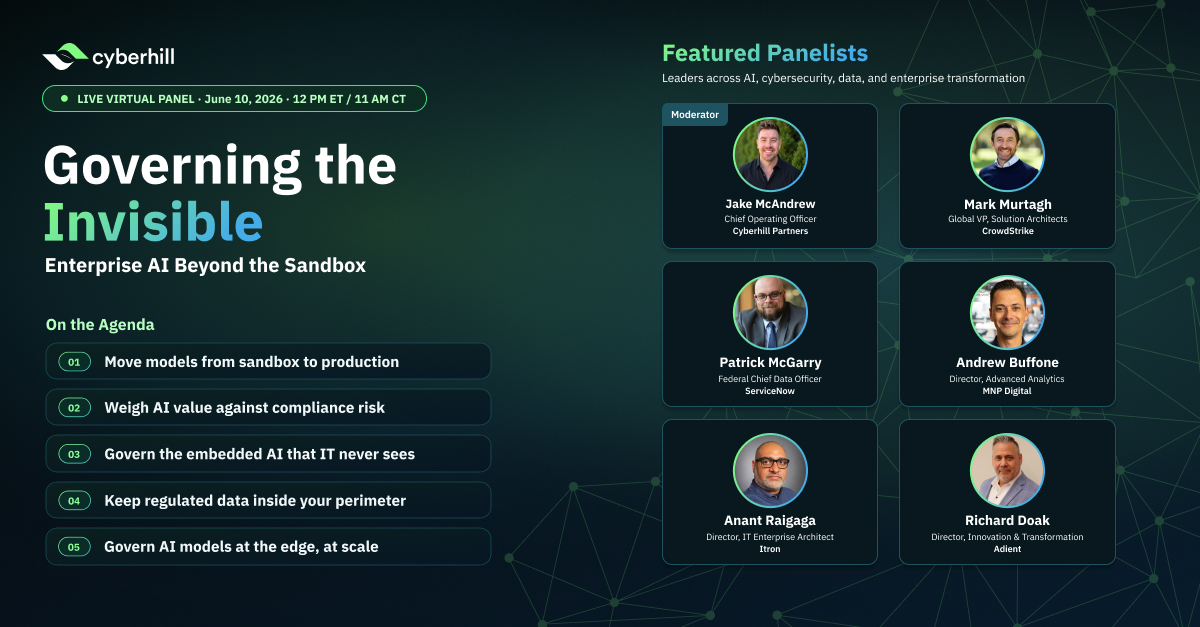
Governing the Invisible: Enterprise AI Beyond the Sandbox
Learn from leaders in the AI Governance space about moving models into production, governing embedded AI, and keeping regulated data inside your perimeter.
LEARN MORE
Palantir AIP vs. Cerebro: Cost, Lock-In, and Who Actually Owns Your AI
In this article: Palantir’s commercial momentum is real. AIP and Foundry are genuinely powerful platforms, and for certain organizations, they’re the right call. But “powerful” and “right for your enterprise”…
LEARN MORE